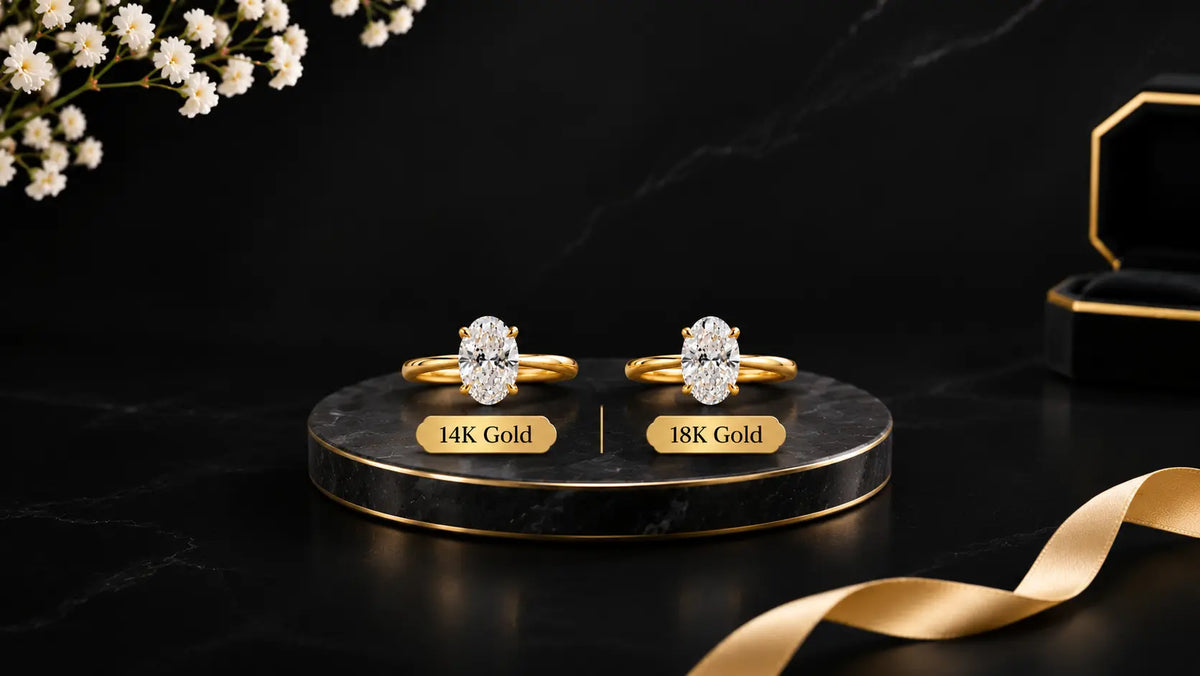
When choosing your engagement ring, it can be helpful to understand your gold options and how each one suits your lifestyle. Two very popular choices are 14K and 18K gold. They are both real gold, but they differ in purity, durability, colour and price.
It can be helpful to understand the benefits of each option. If you want a ring with a higher gold content, you may prefer a higher carat. However, if you wear your jewellery regularly, you may want to consider a lower carat.
There isn't a one-size-fits-all choice, so it will depend on your lifestyle and personal style.
Difference Between 14K and 18K Gold
The main difference between 14K and 18K gold is how much pure gold each contains.
As pure gold is a very soft metal, it needs to be alloyed with other metals such as copper, silver and zinc. Depending on the type and colour of gold being created, the mixture will vary.
14K gold contains around 58.5% pure gold and 41.5% other metals. It is commonly marked 585, although 583 is also used. Meanwhile, 18K gold contains 75% pure gold and 25% other metals. This is commonly marked 750.
Both are considered solid gold. However, this doesn't refer to the quality of the diamond or gemstone; it simply refers to how much gold is within the metal. 18K gold will generally be more valuable because it contains a higher amount of pure gold.
For more information, you can read the GIA guide to gold purity and colour.
14K Gold Durability – Is This Better for Regular Wear?
One of the most important factors to consider when choosing your engagement ring is durability. Most people will wear their ring regularly, so it should be able to withstand everyday activities.
14K gold contains a higher proportion of alloy metals, which generally makes it harder and more resistant to scratching than 18K gold. If you work with your hands or regularly exercise, 14K gold can be a great option. This also depends on how the ring is designed. A thinner band can still bend or become damaged when it hits a hard surface.
Whilst 14K gold isn't unbreakable, it is a popular choice because it offers a good balance between gold content and durability.
You can also read the GIA guide to choosing a ring material for everyday wear for more information.
18K Gold for Daily Wear – Can This Be Worn Regularly?
Yes! If you prefer a higher amount of gold content, 18K gold can also be a great choice for regular wear.
As there is more pure gold in 18K gold, it will generally be softer than 14K gold and may be more prone to scratching.
Many people choose 18K gold for their engagement rings and wedding jewellery. However, if you choose this option, you should be careful during activities that could cause your ring to hit something or come under pressure. Taking it off whilst doing heavy work, exercising or cleaning can help protect the band and setting.
It really depends on your lifestyle and how much you're happy to look after your jewellery.
14K or 18K Gold Engagement Rings – Which Has the Best Colour?
The colour will differ between the two. Depending on how much pure gold is in the metal and what alloys it is mixed with, the colour can change. The colour will also depend on the alloy mixture and won't be identical across different jewellery brands.
Yellow Gold
Yellow gold naturally has a warm colour.
18K yellow gold will generally have a richer and deeper yellow colour because it contains more pure gold. 14K yellow gold often has a lighter and softer yellow colour.
If you love a bold, traditional gold colour, then 18K gold may be more your style. However, if you want a subtler colour, 14K may be the way to go.
White Gold
White gold is created by mixing gold with white alloy metals. Both 14K and 18K white gold can have a bright, silvery appearance.
Some white gold jewellery has rhodium plating to create a bright white finish. This plating can wear away over time.
Rose Gold
Rose gold has a warm pink colour because copper is used in the alloy.
Both 14K and 18K rose gold are available. The colours can vary depending on how much copper and other metals are used.
It can be helpful to look at the actual ring before making a decision. Your skin tone, personal style and centre stone colour can also affect which option you prefer.
For a closer look at different gold colours, explore the GIA guide to white, yellow and rose gold engagement rings.
Engagement Ring Metal Comparison: 14K or 18K Gold – Which Is More Expensive?
18K gold is generally more expensive than 14K gold because it contains a higher proportion of pure gold. For the same weight of metal, 18K gold contains more gold than 14K gold, which can make it more expensive.
However, the price of your engagement ring will depend on other factors:
- How much gold is used.
- The design and setting.
- The size and quality of the centre diamond.
- The number of additional stones.
- The quality of craftsmanship.
- Whether it is bespoke or made to order.
A detailed 14K ring can be more expensive than a simple 18K ring if it has a larger diamond or a more complex design.
If you have a budget to stick to, looking at the whole ring can help you make a better decision.
Looking After 14K and 18K Gold Engagement Rings
Both 14K and 18K gold engagement rings need regular care and upkeep.
Your ring can come into contact with dirt, oils, makeup, cleaning products and everyday knocks, which can affect its appearance and setting.
Here are some simple ways to look after your ring:
- Clean your ring using warm water, mild soap and a soft brush. Avoid harsh chemicals.
- Remove your ring when exercising, gardening, doing heavy cleaning or taking part in any activity that could cause it to hit something.
- Store your ring in a separate jewellery box or soft pouch. This will help prevent scratches.
- If you have a diamond or gemstone in your engagement ring, ask a professional to check it occasionally. This can help identify loose stones or signs of wear.
- Try not to expose your ring to harsh chemicals. Household cleaning products, chlorine and other chemicals can affect jewellery finishes and some alloys.
Both 14K and 18K gold can scratch when worn regularly. Ask a professional jeweller for advice about cleaning or polishing your ring.
For more jewellery care advice, visit our frequently asked questions page.
14K or 18K Gold Engagement Rings – What Should You Choose?
It really depends on what is most important to you.
Choose 14K Gold If:
- You want something practical to wear regularly.
- You want a harder gold alloy that is generally more scratch-resistant.
- You want a good balance between gold content and price.
- You like a slightly softer yellow gold colour.
Choose 18K Gold If:
- You want a higher amount of pure gold.
- You love the richer yellow gold colour.
- You're happy to take extra care of your jewellery.
- You're happy to pay a bit more for a higher gold content.
Many people choose 14K gold because it offers a great balance between durability, colour and price. However, many people still choose 18K gold because of its beautiful appearance. If you value purity and colour, then 18K may be a better option.
There is no single answer that applies to all couples. Consider how often you wear your jewellery, what type of work you do and what look you want.
Frequently Asked Questions
Is 14K gold real gold?
Yes! 14K gold is real gold. It contains around 58.5% pure gold and is mixed with other metals. It is commonly used in fine jewellery and engagement rings.
Does 18K gold last longer than 14K?
Both can last many years with the correct care. However, 14K gold will generally be harder and more scratch-resistant because it contains a higher proportion of alloy metals. How long your ring lasts will also depend on how it is made, its setting and how it is worn.
Does 18K gold tarnish?
18K gold is generally resistant to tarnishing because of its high gold content. However, the other metals in the alloy, the finish and exposure to chemicals can affect its colour.
Can I wear a 14K gold engagement ring regularly?
Yes! 14K gold is a popular choice for regular wear because it offers a good balance between gold purity and durability. However, it should still be cared for correctly to avoid scratches or damage.
Is 18K gold worth paying more for?
It can be if you prefer a higher gold content. If durability and price are your priorities, then 14K gold may be a better option.
Find Your Perfect Engagement Ring for Your Lifestyle
Both 14K and 18K gold have their own benefits. 14K gold is a practical option for regular wear, while 18K gold has a higher gold content.
At Siara By Ark, our engagement ring collection features lab-grown diamonds set in solid gold. We focus on quality craftsmanship, classic designs and personal styles. Our current collection features 14K gold in yellow, white and rose. If you would like to create a bespoke 18K design, please contact us to confirm the available options.
Take your time to compare the metal, setting and centre stone. The best engagement ring will be one you feel comfortable wearing and are happy looking at every day.
Share:
How to Design a Custom Engagement Ring in Australia: Process, Cost and Timeline